
How to improve Shopify conversion
Start with what is holding shoppers back.
To improve conversion on Shopify, identify where shoppers get stuck, fix problems that prevent purchase and make buying information easier to find. When the live journey suggests hesitation, relevant contextual guidance can help address an unanswered question. Review what happens next.
- Check the data. Find where progress weakens and which shoppers are affected.
- Remove practical barriers. Check stock, pricing, shipping and the purchase flow.
- Make the decision easier. Explain product differences, delivery and returns clearly.
- Offer useful help in the moment. Bring relevant information forward when the shopping context suggests a buying doubt.
- Follow the outcome. Review next steps, purchases and recurring questions.
Conversion rate optimisation (CRO) means improving an experience so a greater proportion of visitors complete a desired action. For a Shopify store, the main goal is usually a purchase. Signalbuy adds a proactive tool to that work, using shopper context to offer useful guidance from approved store knowledge.
The opportunity is to act while the shopper is still deciding: help resolve the question that may be standing between interest and a purchase.
Your wider CRO work continues to improve the storefront. Contextual messaging can bring the right information into a particular buying moment. The two approaches can also inform each other: recurring questions reveal what the store needs to explain more clearly.
Work alongside the principles
What is Shopify CRO, and where does Signalbuy fit?
Shopify CRO uses evidence about how people shop to improve the buying journey. It can include product information, navigation, mobile usability, checkout and help with unanswered questions. The aim is to make purchasing easier for the right shoppers.
Established research gives us a useful foundation. The applications below show how Signalbuy can put those principles to work during the shopping journey.
- Understand behaviour. CXL’s ResearchXL framework combines analytics, technical checks, customer research and usability observation to investigate conversion barriers. Signalbuy applies attention to context within the live journey, looking at the sequence before deciding whether guidance could help. CXL’s conversion research framework.
- Reduce friction. Baymard’s research distinguishes checkout difficulties from people who are still browsing or not ready to buy. Fix obstacles in the store, and be selective about intervention. A pause alone is not a reason to send a message. Baymard’s abandonment research.
- Provide decision-making information. Nielsen Norman Group’s product-page research highlights complete information, comparisons, reviews and clear purchase options. Signalbuy can bring relevant approved information forward when the journey suggests an unanswered question. NN/g’s product-page research.
- Learn from outcomes. Follow what shoppers do after receiving guidance. Use conversations and assisted journeys to understand recurring questions, while keeping the distinction between observed activity and additional sales caused by the intervention.
The shift is from identifying a possible information gap to responding to it within the existing experience. A CRO finding can become a store improvement, a contextual answer, or both. Broader research and experiments still have their place in the CRO programme.
Read the context
What might be holding this shopper back?
In Shopify’s conversion reporting, review sessions, cart additions, checkout and purchase. Compare relevant devices, traffic sources, landing pages and countries. Use consistent reporting periods and account for changes in promotions or availability. Shopify’s conversion reporting.
Use that store-level view to find recurring friction. Use the live journey to judge whether this shopper may benefit from guidance now. These are related questions at different levels.
- Can they buy? Check availability, pricing, shipping coverage and the purchase flow. A message cannot fix unavailable stock or a broken payment step.
- Can they decide? Look for uncertainty about suitability, differences between products, delivery or returns. Relevant information may help with this kind of barrier.
- Is there a useful reason to speak? Consider the sequence of interactions. A product revisit or policy check can be normal browsing as well as a sign of hesitation.
For example, repeated delivery checks after viewing a product may suggest a practical buying question. That is a possibility to interpret, not certainty about what the shopper is thinking.
Improve the buying journey
A practical Shopify CRO checklist.
Use the friction you find to choose where to start. These checks complement contextual guidance and reflect Shopify’s ecommerce CRO guidance.
- Product pages. Make the price, availability, variants and add-to-basket action clear. Explain suitability with useful images, specifications and genuine customer reviews where available.
- Delivery and returns. Show costs, realistic delivery timings and return conditions before checkout. Make any thresholds or exclusions easy to understand.
- Mobile shopping. Walk through a purchase on a phone. Check readable text, usable controls, form fields and page speed. Look for overlays that interrupt the next step.
- Checkout. Check shipping eligibility, available payment methods and error messages. Review whether account requirements or unnecessary steps make purchasing harder.
Address a broken purchase step first. Then focus on recurring barriers affecting relevant shoppers. Some need a store change; others need information at the right moment. A clear delivery page and a useful delivery message can serve the same CRO goal.
From context to action
Bring the answer into the buying moment.
The delivery policy may already be accurate and accessible. Yet a shopper can still be unsure whether the order timing meets their needs. Signalbuy can bring the relevant part of that knowledge into the moment.
- Read the journey.A shopper views a product, checks delivery options and revisits delivery information.
- Recognise a possible doubt.The sequence may suggest uncertainty about when the order will be sent.
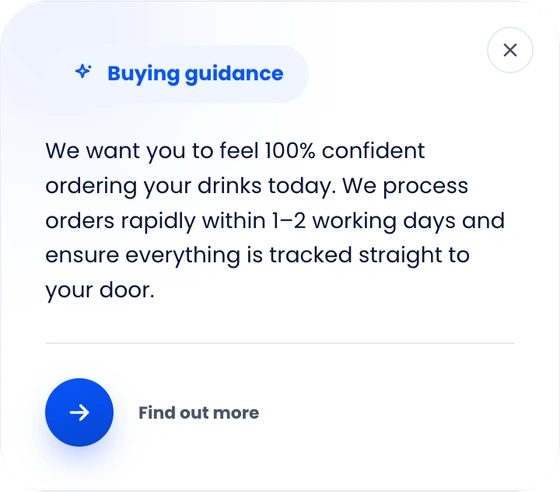
- Offer useful guidance.Bring forward the approved dispatch and tracking information in a contextual message.
- Help the next step.The shopper can continue deciding or ask a follow-up question through AI Q&A.
The immediate CRO action is useful guidance within the existing shopping experience. It gives the shopper information that may help them move forward, while they are still there.
The value is in the message
Offer information that helps with the decision.
Recognising the topic is only part of the job. The first interaction should give the shopper something useful.
- A generic greeting. “Can I help?” opens a conversation, but leaves the shopper to explain the problem.
- A topic-aware prompt. “Do you have a question about delivery?” recognises a possible concern, but still asks the shopper to do the work.
- Useful contextual guidance. “Orders are processed within 1–2 working days, with tracked delivery.” This gives relevant information immediately, provided it reflects the store’s actual policy.
The delivery wording illustrates the distinction; each store needs its own accurate answer. Dispatch time and arrival time are different. A useful message should make clear which it describes.
For CRO, the question becomes: did this interaction help resolve the buying doubt? Simply starting more conversations is not the objective.
Explore proactive AI chat for ShopifyPut the principle into practice
One buying barrier.
Two ways to help.
The store improvement helps everyone who needs the information. Contextual guidance can bring it forward when an individual journey suggests it would be useful.
- Choosing between products. Improve the page with clear differences, specifications and suitability information. When repeated comparisons suggest uncertainty, contextual guidance can surface the relevant approved distinction.
- Understanding delivery. Make costs, timing and service conditions easy to find. When the shopper repeatedly checks delivery, a message can bring forward the applicable information.
- Feeling confident about returns. Explain the policy clearly on the store. When the journey suggests a returns concern, contextual guidance can explain the approved conditions and link to the full policy.
These are illustrative patterns, not automatic trigger rules. Relevance depends on the journey, the knowledge available and your controls. If the same question keeps appearing, use that insight to improve the underlying content too.
Explore more shopper hesitation examplesPut the tool to work
Connect your knowledge, journey and controls.
- Approve the information. Use current product details, category guidance, reviews, delivery and returns information. Resolve missing or conflicting answers at the source.
- Read the shopping context. Consider the sequence of interactions and the possible buying question, rather than treating every page visit as a request for help.
- Control when to speak. Set the triggers, frequency, placement and voice. Tailor the treatment of new, returning and logged-in shoppers. Staying quiet can be the useful outcome.
- Offer the answer and continue naturally. Give the useful contextual message first. Let AI Q&A handle follow-up buying questions from approved knowledge.
Review the complete interaction: what happened before the message, what information it used, whether it addressed the possible doubt and what the shopper did next.
See Signalbuy in actionFollow the outcome
Connect guidance with the buying journey.
Review conversations alongside subsequent shopping activity and assisted revenue. Look beyond whether a message was opened.
- Message quality. Was the information accurate, relevant and useful in that context?
- The next step. Did the shopper continue considering the product, ask a useful follow-up question, add to basket or purchase?
- Recurring friction. Which buying questions keep appearing, and what could you improve in the store itself?
- The wider experience. Was the guidance well timed and restrained? Did it create confusion or unnecessary interruptions?
Shopify defines online store conversion rate as the percentage of sessions that result in an order. Keep the report, date range and filters consistent, and review orders and revenue alongside that rate. Shopify’s metric definitions.
For example, 200 converting sessions out of 10,000 sessions = 2%. This illustrates the calculation, not a Signalbuy result.
Assisted revenue links purchases to journeys involving guidance. It does not, on its own, establish how many additional purchases the guidance caused. Keep that distinction clear when reporting outcomes.
A current reporting consideration: Shopify changed session measurement and bot filtering during 21–23 September 2026. Rates can move without a change in orders or sales. Use a baseline after the update and consistent filters when reviewing session-based trends. Read Shopify’s measurement update.
Read more about measuring AI chat outcomesCommon questions about Shopify CRO.
Why does my Shopify store get traffic but no sales?
Possible causes include visitors who are not ready to buy, a mismatch between the traffic and the offer, unclear product information, unexpected costs or purchase difficulties. Check the funnel and relevant customer journeys before deciding which barrier to address.
Is Signalbuy an A/B testing tool?
No. Signalbuy reads the shopping journey and offers contextual buying guidance at signs of hesitation. Its immediate action is a useful message within the existing experience. It can work alongside the research, store improvements and experiments in a wider CRO programme.
How does proactive AI chat fit into Shopify CRO?
It gives merchants another way to address buying friction: bring relevant information from approved store knowledge to a shopper who may need it, while they are still deciding.
Does this replace improving product pages and checkout?
No. Clear product information and a working purchase flow remain essential. Proactive guidance can help with a buying question in context; recurring questions can also reveal where the store itself needs clearer information.
What is a good Shopify conversion rate?
It depends on your products, prices, traffic sources and customer mix. Start with a consistently measured baseline for your store. A general industry average is not a universal target or a forecast of what guidance will deliver.
Research behind the approach
Established principles.
A proactive way to act on them.
The research linked in this guide informs the underlying principles: understand friction, provide useful buying information and interpret outcomes carefully. The Signalbuy workflow and practical examples are our application of those principles.
- CXL. ResearchXL: using different forms of evidence to understand conversion barriers.
- Nielsen Norman Group. Katie Sherwin’s research on product information and purchase decisions.
- Baymard Institute. Checkout usability, abandonment and the distinction between browsing and buying difficulties.
- Shopify. Practical ecommerce CRO guidance, official conversion definitions and session-measurement guidance.
Written by Signalbuy. Sources checked and guide updated on . Product demonstrations and worked examples are not customer outcome studies.